
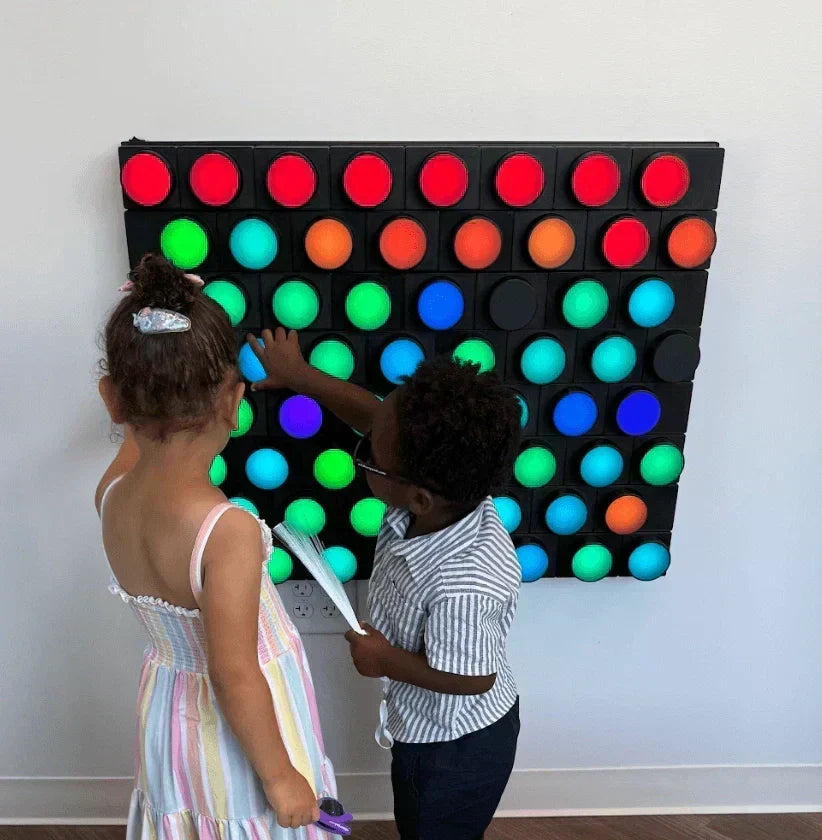
Sensory play is one of those terms that gets used often in parenting and early childhood circles — but rarely explained well.
It's more than finger painting or a bin of kinetic sand. Sensory play is any activity that engages and challenges a child's sensory systems — and understanding why it matters can fundamentally change how you think about designing your child's environment.
At Smart Playrooms®, sensory experience is built into everything we design. Here's what the science actually says, and why it should inform every decision you make about your child's play space.
What Are the Sensory Systems?
Most of us learned about five senses in school. In child development, the picture is more complete — and more interesting.
Children actually have eight sensory systems, each of which needs regular input to develop properly:
- Tactile — touch, texture, temperature, pressure
- Vestibular — balance, movement, spatial orientation (governed by the inner ear)
- Proprioceptive — body awareness, the sense of where your limbs are in space
- Visual — sight and visual processing
- Auditory — sound and auditory processing
- Olfactory — smell
- Gustatory — taste
- Interoceptive — internal body signals like hunger, thirst, and emotional awareness
The three systems most directly supported by intentional play design are vestibular, proprioceptive, and tactile — and these are also the three most commonly under-stimulated in modern indoor environments.

Why Sensory Input Matters for Development
The brain develops through experience. Every time a child receives sensory input — swinging, climbing, touching different textures, balancing — neural pathways are formed and strengthened.
This process, called sensory integration, is foundational to nearly every area of development:
- Emotional regulation — children who receive adequate sensory input are better able to manage their emotions and behavior
- Focus and attention — a well-regulated sensory system supports the ability to sit, concentrate, and engage in learning
- Gross and fine motor skills — proprioceptive and vestibular input directly support coordination, strength, and physical confidence
- Social development — children who feel comfortable in their bodies are more confident in social interactions
- Language and cognition — sensory play supports the brain development that underlies language acquisition and problem-solving
When sensory needs aren't met, children seek that input in other ways — often through behaviors that feel disruptive or challenging. A well-designed play environment addresses those needs proactively.
The Role of Vestibular Input
The vestibular system is one of the most powerful and most overlooked sensory systems in child development.
Located in the inner ear, it governs balance, spatial orientation, and the sense of movement through space. It is directly connected to the parts of the brain responsible for attention, emotional regulation, and visual processing.
Children who receive regular vestibular input — through swinging, spinning, rocking, and climbing — show measurable improvements in:
- Focus and sustained attention
- Emotional stability
- Reading and language processing
- Body awareness and coordination
Our Swinging collection is designed specifically with vestibular development in mind. A cocoon swing provides the gentle, enveloping vestibular input that many children find deeply regulating — while a platform swing offers a more dynamic, full-body experience. Both serve different sensory needs and can be valuable in the same space.

The Role of Proprioceptive Input
Proprioception — the body's sense of itself in space — is developed through heavy work: pushing, pulling, carrying, climbing, and lifting.
When children climb a rock wall, cross monkey bars, or navigate a ninja-style obstacle course, they are providing their proprioceptive system with exactly the input it needs.This kind of full-body physical challenge:
- Builds body awareness and coordination
- Supports emotional regulation and calming
- Develops core strength and postural stability
- Prepares the body for fine motor tasks like writing
Proprioceptive input is also one of the most effective natural tools for helping children who feel dysregulated — anxious, overstimulated, or hyperactive — return to a calm, focused state.
The Role of Tactile Input
Tactile processing — the ability to interpret and respond to touch — underpins many everyday skills, from handwriting to social comfort to the ability to tolerate clothing, textures, and physical contact.
A well-designed play environment offers varied tactile experiences: different textures, surfaces, and materials that challenge and develop the tactile system naturally through play.
Our Sensory Essentials collection and Toddler collection are built around this principle — offering equipment that provides meaningful tactile input in an age-appropriate, beautiful way.
Designing a Sensory-Intelligent Play Space
Understanding sensory development changes how you approach playroom design. Rather than simply filling a space with equipment, the goal is to create an environment that addresses each child's sensory profile thoughtfully.
A well-designed sensory play space typically includes:
- A swing for vestibular regulation — explore our Swinging collection
- A climbing element for proprioceptive input — explore Climbing Essentials
- Varied textures and surfaces for tactile development — explore Sensory Essentials
- A defined calm space for self-regulation and rest
- Age-appropriate challenge that grows with the child — explore our Toddler collection for younger children, Montessori-aligned options for intentional independent play
Every Smart Playrooms® design begins with sensory function. The result is a space that doesn't just look beautiful — it actively supports your child's development every time they use it.

What This Means for Your Family
You don't need to be an occupational therapist to create a sensory-intelligent environment for your child. You simply need to understand what your child's body is asking for — and design a space that answers.
A child who swings every morning is regulating their vestibular system before school. A child who climbs after school is processing the sensory demands of the day. A child who retreats to a quiet corner with a weighted blanket is managing their own nervous system with the tools you've given them.
That is intentional play design. And it changes everything.
Change the Way Your Kids Play®
Ready to design a space that truly supports your child's development?
Explore our Sensory Essentials and Smart Essentials collections — or book a Smart-E virtual design session to create a sensory-intelligent playroom tailored to your child and your home.


