
There is a quiet tension in modern parenting between the instinct to protect and the knowledge that protection, taken too far, becomes its own kind of harm.
Nowhere is this tension more visible than in how we design children's play environments. Over the past few decades, playgrounds have been systematically made safer — lower, softer, more predictable. And in that process, something important has been lost.
Children need challenge. They need the experience of attempting something difficult, managing real physical risk, and discovering what they are capable of. Without it, they do not become safer. They become less confident, less resilient, and less prepared for the challenges that life will inevitably present.
At Smart Playrooms®, we design for what researchers call risky play — and we do it intentionally, thoughtfully, and without apology.
What Risky Play Actually Means
Risky play is not reckless play. The distinction matters.
Reckless play involves genuine danger — hazards a child cannot perceive or manage. Risky play involves challenge — physical or situational demands that are within a child's developmental reach but require genuine effort, courage, and skill.
Researchers identify several categories of risky play that children are naturally drawn to:
- Play at height — climbing, jumping from elevated surfaces
- Play with speed — sliding, swinging, running
- Play with rough and tumble elements — wrestling, chasing, contact
- Play near edges or with the possibility of getting lost
- Play with tools or elements that require care and judgment
When children engage in this kind of play in a well-designed environment, the outcomes are consistently positive — developmentally, emotionally, and physically.

What the Research Shows
The evidence in favor of risky play is substantial and growing.
Studies consistently show that children who engage in regular risky play demonstrate:
- Greater physical competence — stronger bodies, better coordination, more refined motor skills
- Higher risk literacy — the ability to accurately assess and manage real-world risk
- Stronger emotional resilience — greater tolerance for frustration, discomfort, and failure
- Reduced anxiety — children who are regularly exposed to manageable challenge develop more robust stress response systems
- Higher self-efficacy — the deep belief that they are capable of hard things
Perhaps most significantly, research suggests that children who are deprived of risky play do not become safer. They become more anxious, less capable of managing uncertainty, and more likely to take genuinely dangerous risks in unsupervised settings — precisely because they have never had the opportunity to develop risk literacy in a supported environment.
The Role of the Home Environment
Outdoor risky play — trees to climb, hills to roll down, spaces to explore — is irreplaceable. But it is not always available, and it is subject to weather, neighborhood, and parental availability in ways that limit its consistency.
A well-designed indoor play environment can provide meaningful risky play opportunities every day, in a setting that is safe without being sanitized.
The key word is designed. The difference between a genuinely developmental risky play environment and a hazardous one is intentionality — equipment built to the right specifications, installed correctly, with appropriate fall zones and surfaces, offering real challenge within a well-considered safety framework.
This is the design philosophy behind our Climbing Essentials collection. Every piece is engineered to offer genuine physical challenge — real height, real effort, real accomplishment — within a structure that manages actual hazard without eliminating the experience of risk.

Climbing as Risky Play
Climbing is perhaps the most complete form of risky play available to children.
It involves height, physical demand, problem-solving, and the management of real — if controlled — risk. Every time a child climbs higher than they have before, they are engaging in an act of genuine courage. Every time they reach the top, they are building something that no amount of passive entertainment can provide: the visceral knowledge that they can do hard things.
Our rock wall panels are designed to grow with children — offering different hold configurations, increasing difficulty, and genuine challenge at every stage of development. Our monkey bars develop upper body strength, coordination, and the confidence that comes from crossing something that felt impossible last week.
For children who are ready for more, our Ninja collection offers a full range of obstacle and challenge elements that develop agility, problem-solving, strength, and determination simultaneously.
Tumbling and Height Play
The desire to jump, fall, roll, and tumble is universal in children — and deeply developmental.
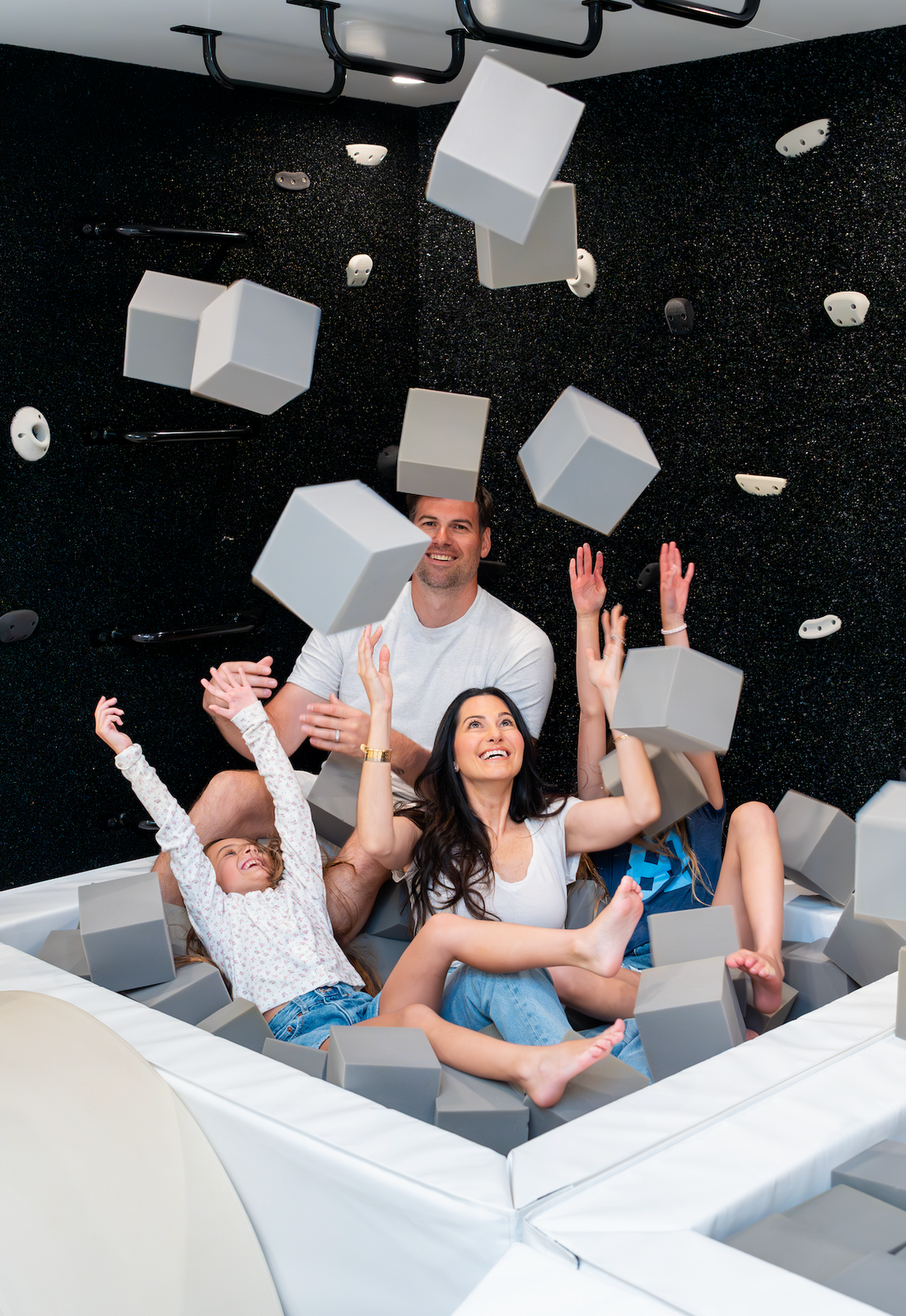
Tumbling develops body awareness, spatial orientation, and physical confidence in ways that other movement forms cannot. Our Tumbling collection is designed to make this kind of play safe, accessible, and genuinely challenging — foam elements, crash mats, and progressive challenge structures that invite children to push their physical limits in a well-designed environment.

What Parents Often Fear — and What They Can Trust
The most common concern about risky play is injury. It is a reasonable concern, and one we take seriously in every design decision we make.
But the research is instructive here too. Studies of children's injuries in play environments consistently show that serious injuries are rare in well-designed settings — and that the developmental cost of eliminating risk far outweighs the statistical risk of injury.
Children get minor bumps and bruises in risky play. They always have. Those minor injuries are part of the learning process — they teach children about their bodies, their limits, and how to calibrate their own risk-taking. They are not failures of design. They are features of childhood.
What well-designed risky play environments eliminate are the genuinely dangerous hazards — the falls from unsafe heights, the entrapment risks, the structural failures — while preserving everything that makes the play meaningful.
Change the Way Your Kids Play®
Ready to give your child the gift of real challenge?
Explore our Climbing Essentials, Ninja collection, and Tumbling collection — designed to support confident, capable, resilient children through the power of intentional risky play.


