
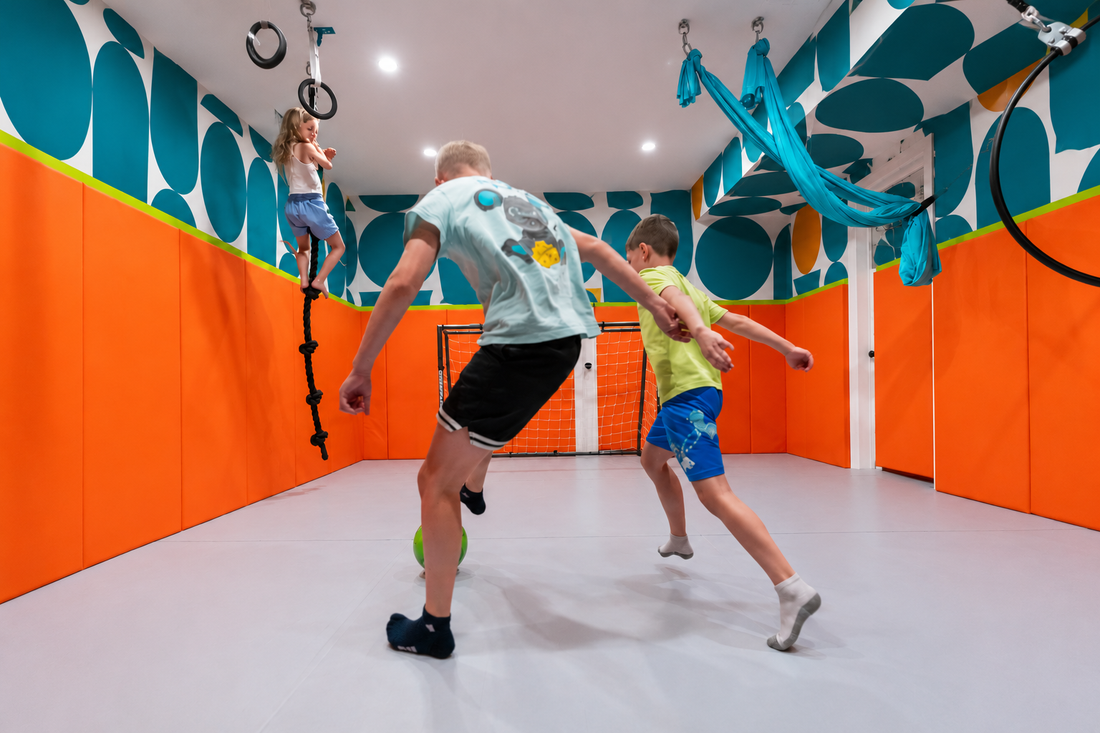
As summer winds down and the school year approaches, most parents focus on the obvious preparations — new supplies, updated wardrobes, adjusted bedtimes.
What rarely makes the list is the one thing that may matter most: making sure your child's body is ready to learn.
The connection between physical readiness and academic performance is well established in child development research. Children who are physically active, sensorially regulated, and physically confident arrive at school in a fundamentally different state than those who are not — and that difference shows up quickly in focus, behavior, and learning.
At Smart Playrooms®, we design environments that support this readiness every day, not just in August. Here's what the research says — and how your home environment can make a real difference this school year.
The Body-Brain Connection in Learning
Learning is not purely a cognitive activity. It is a whole-body experience.
The brain regions responsible for movement are directly connected to those responsible for attention, memory, and executive function. When children move — really move, with challenge and intention — they are not just exercising their bodies. They are priming their brains for learning.
Research consistently shows that children who engage in regular vigorous physical activity demonstrate:
- Stronger working memory and information retention
- Greater ability to sustain attention and resist distraction
- Improved emotional regulation and reduced anxiety
- Better performance across academic subjects, including reading and mathematics
- More positive attitudes toward school and learning
This is not a minor effect. It is one of the most reliable findings in developmental science — and it has direct implications for how we design children's home environments.

What "Ready to Learn" Actually Looks Like
A child who is ready to learn is not simply one who has slept well and eaten breakfast — though both matter.
A child who is ready to learn has a regulated nervous system. Their vestibular system has been activated. Their proprioceptive system has received input. Their body knows where it is in space, and their brain is calm, alert, and open.
This state is most reliably achieved through physical movement — specifically the kind of active, full-body play that our Climbing Essentials and Ninja collection are designed to support.
A child who spends 20 minutes climbing, swinging, or navigating an obstacle course before school arrives at the classroom in a neurologically different state than a child who went from bed to breakfast to car. That difference is felt by teachers, reflected in behavior, and visible in academic engagement.
The Role of the Home Environment
Schools increasingly recognize the importance of movement for learning — but the school day is constrained. Recess is limited. Transition times are brief. The physical demands of a classroom environment — sitting still, managing noise, maintaining focus for extended periods — are significant.
The home environment is where that deficit can be addressed. A well-designed indoor play space means that movement is available before school, after school, and on every day in between.
Our Smart Essentials collection is designed around this principle — curated combinations of equipment that support the full range of developmental needs in a single, beautifully designed space.
For families focused on academic readiness, we also recommend incorporating STEM Activities that bridge physical and cognitive challenge — building, constructing, and problem-solving through play.

Emotional Regulation: The Overlooked Factor
Of all the factors that influence school readiness, emotional regulation may be the most important — and the most directly supported by physical play.
A child who cannot regulate their emotions struggles in every area of school life: relationships with peers, responses to frustration, ability to transition between activities, and capacity to engage with challenging material.
Physical movement — particularly vestibular input from swinging and proprioceptive input from climbing and heavy work — is one of the most effective tools available for supporting emotional regulation. It is not a replacement for other strategies, but it is a powerful and accessible foundation.
Children who move their bodies regularly, and who have a home environment that makes movement easy and natural, develop stronger self-regulation over time. That is one of the most valuable things a parent can give a child before the school year begins.
Sensory Processing and Classroom Readiness
Many children who struggle in classroom settings are not struggling with intelligence or motivation. They are struggling with sensory processing — the ability to filter, integrate, and respond appropriately to the sensory demands of a busy classroom environment.
A sensory-intelligent home play space helps children develop this capacity. Our Sensory Essentials collection is designed around the sensory systems most directly relevant to school readiness — vestibular, proprioceptive, and tactile — and can be meaningfully integrated into any playroom design.
For younger children preparing for their first school experience, our Toddler collection offers age-appropriate equipment that builds the sensory and physical foundations they will need.

Building the Habit Before September
The most effective time to establish a movement habit is before the school year begins — not after.
Children who arrive at September already accustomed to regular active play, who have a home environment that makes movement natural and automatic, will find the transition to school routines significantly easier.
Consider building a simple morning movement ritual into the last weeks of summer: 15 to 20 minutes of active play before any screens, before leaving the house, before the day's demands begin. The monkey bars, rock wall, or a swing session are ideal for this — high sensory input, full-body engagement, and immediate neurological benefit.
That habit, once established, will carry your child through the school year.
Change the Way Your Kids Play®
Ready to set your child up for their best school year yet?
Explore our Smart Essentials and Climbing Essentials collections — or discover how STEM Activities can bridge physical and cognitive development at home.


